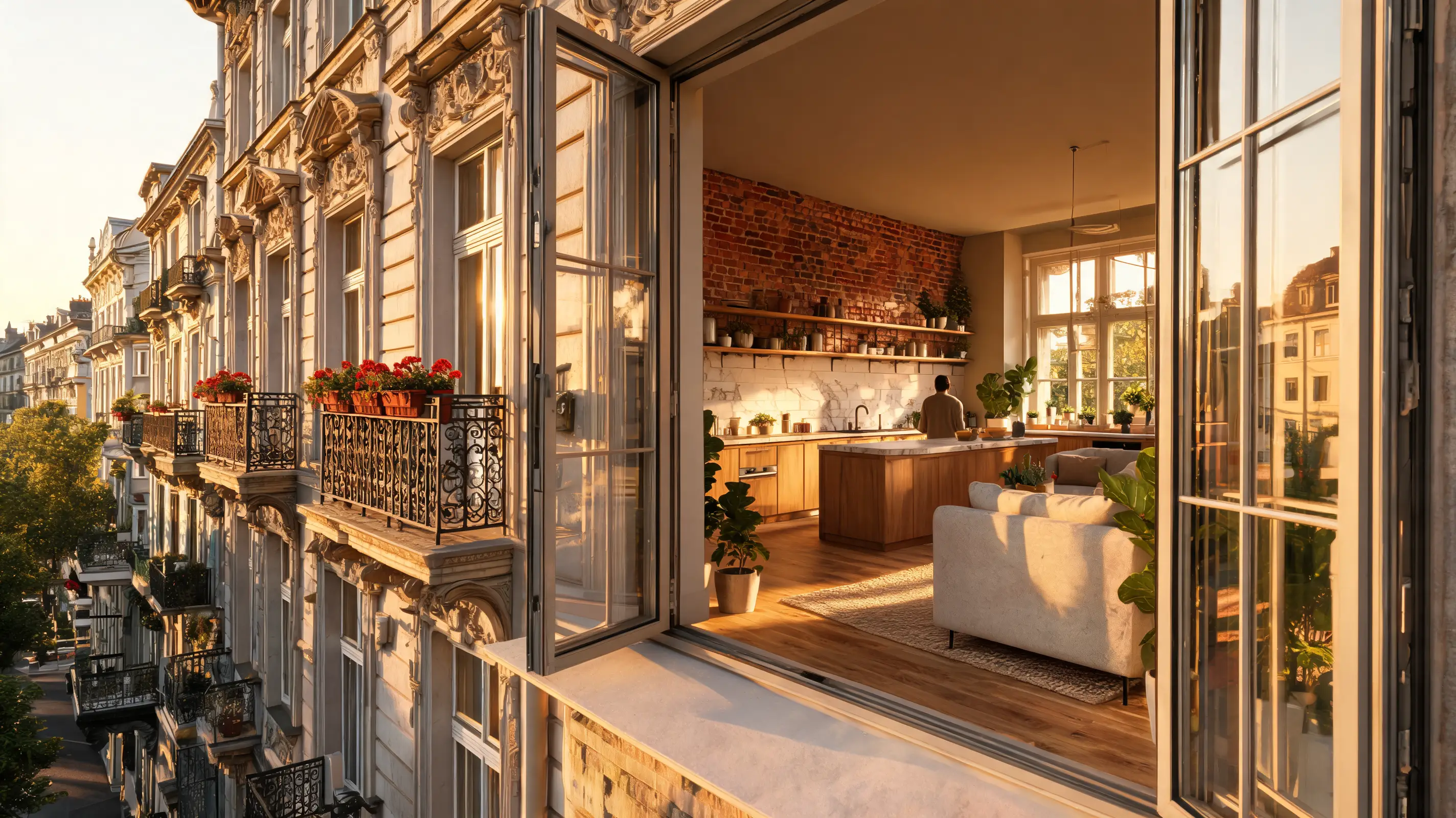
What You Need to Know When Buying an Older Apartment: The Safety Guide from Structure to Community
Acquiring a home is one of the most important financial and personal decisions you will ever make. When the charm of the cobbled streets of Brașov or the historic architecture of Timișoara draws you to buildings erected in past decades, enthusiasm can easily overshadow the necessary vigilance. There is a clear set of unwritten rules about what you need to know when buying an older apartment—rules that make the difference between an incredibly valuable lifetime investment and an endless construction site generating hidden costs.
Whether you are an IT professional looking for a retreat with character, a relocating family, or an investor who understands the irreplaceable value of ultra-central locations, this guide will provide the safety benchmarks you need to look past the cosmetically enhanced appearances of the real estate market.
The Charm of Mature Neighborhoods in Brașov and Timișoara vs. Technical Reality
Mature neighborhoods possess an undeniable magnetism. In Brașov, iconic areas such as Andrei Mureșanu, Centrul Civic, or Melcilor Hill offer quick access to green spaces, tranquility, and spectacular views of Tâmpa. In Timișoara, historic neighborhoods like Cetate, Elisabetin, or Fabric preserve a unique architectural elegance, featuring high ceilings, generous windows, and unparalleled proximity to cultural and business hubs. These areas remain highly attractive because they benefit from complete infrastructure, prestigious schools, and a much lower building density compared to the new commuter towns on the periphery.
However, beyond the facade, an older apartment listed for sale hides details that quick finishes and fresh paint can easily mask at first glance. A coat of white washable paint, applied a week before a viewing, can hide active mold, signs of roof leaks, or alarming structural cracks.
To make a mature purchase, it is essential to transition from aesthetic delight to a lucid, engineering-focused analysis. A premium buyer does not evaluate a space solely by how it "feels" at sunset, but analyzes the quality of the load-bearing structure, the condition of the utility networks, and the health of the community in which they are about to invest their resources.
Verifying the Building's Structure and History
What You Need to Know When Buying an Older Apartment: Verifying the Building's Structure
The first and most important step in evaluating a building constructed before the 1990s is its seismic classification and structural quality. In Romania, seismic design standards were majorly tightened after the 1977 earthquake. Therefore, the building's year of construction is not just a number on the title deeds, but a direct indicator of your safety.
- Seismic risk classes: Ensure the property is not classified under seismic risk classes RsI or RsII (the famous red dots or unresolved emergency categories). This information can be verified on the official lists published by the city halls of Brașov or Timișoara.
- Physical red flags: When visiting the property, look beyond eye level. Inspect the load-bearing beams and columns inside the apartment, as well as in the stairwell. Deep diagonal cracks in the concrete are signs of structural settling, unlike superficial micro-cracks in the plaster.
- The basement and the top floor: Going down into the building's basement will tell you the absolute truth about the property. A flooded basement with a strong smell of dampness and dripping, rusted pipes indicates a negligent homeowners' association and a major risk of foundation degradation. Similarly, on the top floor, the corners of the ceiling will immediately show you if the roof's waterproofing is compromised.
- The building's technical logbook: Ideally, you should request the building's technical logbook. If this no longer exists (a frequent case with older buildings), ask the association about the history of thermal and structural renovations. A building that has been structurally reinforced or thermally insulated through certified programs offers extra safety and much lower maintenance costs.
Utilities and Hidden Infrastructure
When analyzing what to check in an apartment before buying, the internal utilities rank first on the list of extreme unexpected expenses. A cosmetic renovation may seem inexpensive, but replacing the electrical and plumbing networks inside the walls involves massive costs for stripping and restoration.
Electrical Systems: Copper vs. Aluminum
Buildings constructed before 1990 used aluminum wiring almost exclusively. Aluminum becomes brittle over time, heats up much faster, and is not designed for the power consumption generated by modern appliances (dishwashers, dryers, air conditioning units, espresso machines). Completely replacing an aluminum network with a modern copper one, including the fuse box and wall routing, can easily exceed €4,000 - €6,000 for a 3-room apartment.
| Wiring Type | Estimated Lifespan | High-Consumption Safety | Estimated Replacement Cost (3 rooms) |
|---|---|---|---|
| Aluminum (old) | 20 - 30 years (obsolete) | Low (risk of overheating) | - |
| Copper (modern) | Over 50 years | High (supports high-draw appliances) | 4,000 - 6,000 EUR |
Plumbing and Heating Systems
Do not forget to check the water pressure during peak hours (morning and evening), especially if you are purchasing an apartment located on the upper floors (7-10). Shared cast-iron or galvanized risers, unchanged for decades, accumulate limescale and rust deposits that reduce pressure and can back up at any time.
Additionally, analyze the heating system. If the building is still connected to the centralized district heating system, inquire about its efficiency in that specific area. If the apartment has its own boiler, request a valid periodic technical inspection (VTP) and evaluate the age of the equipment.
Thermal and Acoustic Insulation
The thick brick walls of interwar buildings in Timișoara offer excellent thermal inertia, but communist-era concrete panel buildings strictly require exterior insulation with polystyrene or high-density mineral wool. Furthermore, your daily comfort depends directly on the thickness of the partition walls and the quality of your neighbors. A thin AAC wall between you and the neighboring apartment will completely compromise your privacy.
Legal and Administrative Risks in Buying an Older Apartment
The physical condition of the apartment is only half of the equation; the other half is represented by the legal file and the administrative context of the property.
- The financial health of the association: Before signing a promissory sale agreement, visit the president or administrator of the homeowners' association. Request a certificate proving that the current owner has no outstanding maintenance fees. Ask explicitly if there are ongoing lawsuits against the association, large debts from other tenants that could lead to hot water or heating shut-offs, and if there is a solid repair fund established for restoring the roof or the elevator.
- Ownership history and successions: Older properties often go through decades of legal history: successive sales, inheritances, divisions of property, or restitution claims (especially in the historic areas of Brașov and Timișoara). A clean land registry extract is mandatory, but an experienced notary must analyze the entire chain of title deeds to rule out the risk of subsequent claims from heirs excluded from the succession.
- Unauthorized interior modifications: Many owners have chosen to tear down storage closets, merge the kitchen with the living room, or remove balcony parapets to gain space. Always compare the cadastral survey (releveul) with the actual layout on-site. If walls have been demolished without a building permit (even non-structural ones), you risk hefty fines, the obligation to restore the space to its original state at your own expense, and, most importantly, the rejection of your mortgage application by the bank if the purchase is financed through a loan.
Eliminating Uncertainty: Ultra-Fidelity Digital Viewings vs. Classic 3D Tours
Identifying all these details requires time and energy. Traditionally, buyers spend dozens of hours in traffic in Brașov or Timișoara, attending viewings that turn out to be major disappointments: rooms that look much smaller in reality, damp corners strategically hidden in photos behind pieces of furniture, or cheap finishes marketed as "luxury."
The wide-angle photographs used by traditional agencies completely distort proportions and perspectives. Furthermore, standard 3D tours based on "dollhouse" platforms (such as Matterport) offer a harsh volumetric rendering with unrealistic reflections and artificial textures that mask the actual issues of the walls and materials used.
To completely eliminate this uncertainty, we approach premium real estate presentation from a different perspective. We offer photorealistic 3D tours of microscopic fidelity for our portfolio of properties. Our advanced scanning technology does not distort space; instead, it renders with absolute precision:
- The true texture of walls and materials: You can observe the quality of the finishes, the condition of the hardwood floors, the tile joints, and any potential imperfections on the walls.
- Authentic natural light: You will understand exactly how light enters the rooms based on the building's cardinal orientation, without artificial overexposures that hide dark corners.
- Exact proportions: No lens effects that artificially enlarge rooms; the dimensions you see online are exactly what you will find on-site.
This premium digital experience allows you to filter properties with the rigor of an expert from the comfort of your office or home, saving dozens of hours of unnecessary travel and giving you the confidence that what you see is exactly what you buy.
Frequently Asked Questions
What is the difference between an older concrete building and a brick one?
Brick buildings (especially interwar ones or those from the early years of the communist regime) offer superior natural acoustic and thermal insulation, high ceilings, and often more generous layouts. Prefabricated concrete panel buildings are more rigid, can present more pronounced thermal bridges at joints, and drastically limit the possibility of making interior modifications (as most walls are load-bearing).
What documents should I request from the seller before submitting an offer?
Request the Land Registry Extract for information purposes (no older than 30 days), the title deed (sale contract, donation, inheritance certificate), the complete cadastral documentation (the survey approved by OCPI), the Energy Performance Certificate, and a certificate from the homeowners' association proving the absence of debts.
How can I find out the seismic risk class of a building in Brașov or Timișoara?
The information is public and can be accessed on the official websites of the Brașov City Hall and Timișoara City Hall, in the sections dedicated to urban planning or emergency situations, where the lists of technically assessed buildings classified into seismic risk categories are periodically updated.