
Reviewed by Luiza Balojin, real estate agent, on September 24, 2026.
PAD is Romania's mandatory home insurance. Below you will find the practical answers, one at a time: what it means, whether it is mandatory, what it covers, which details you need, who can take it out, what it costs, where to get it, how to check it and what to do after damage or when a home is sold. The rules come from Legea 260/2008 (Law 260/2008) and from padrom.ro.
What PAD means
Law 260/2008 (art. 2) defines the PAD contract as the contract insuring a home against natural disasters. By natural disaster, the law means three risks, as natural phenomena: earthquakes, landslides and floods. In short, PAD is the mandatory policy that insures your home against these three risks.
Behind it stands PAID, the Pool-ul de Asigurare Împotriva Dezastrelor Naturale (Natural Disaster Insurance Pool). A genuine PAD policy carries the PAID logo in the top left corner, and when there is damage, PAID pays the compensation.
Is PAD insurance mandatory?
Yes. Under Law 260/2008, art. 3, owners, whether individuals or companies, must insure homes registered as dwellings with the tax authority, in towns and villages alike.
Two special cases:
- A home under financial leasing. The insurance is taken out by the lessor, the party that leases the home out.
- A building assessed in seismic risk class I. Homes in it are not insured through PAD until the strengthening works are formally accepted.
If you are buying with a mortgage, what insurance the bank may ask for on top of PAD, and what rights you have, is covered in our guide to mandatory insurance and your mortgage.
What PAD insurance covers
PAD covers the home against three risks, as natural phenomena:
- earthquakes;
- landslides;
- floods.
These are the only risks listed in the contract. Under Law 260/2008, PAD does not cover:
- outbuildings and fittings that are not structurally attached to the building;
- the contents of the home, such as furniture, appliances and your belongings.
Compensation has a ceiling, the sum insured, which depends on the type of home. You will find it below, under cost.
Documents and details you need for a PAD policy
For a PAD policy you fill in the details of the home. The PAD contract model in force since March 1, 2026 asks for these:
- the address;
- the floor area;
- the number of rooms;
- the year of construction;
- the height regime (how many levels the building has);
- the carte funciară (land register) number, optional.
On top of these, the policy records the details of the insured person and, if it is someone else, of the policyholder who takes it out. You also need to know what the home is built from, because that decides its type, A or B.
Our advice: keep your ownership deed at hand and take these details from it, so you do not fill them in from memory.
Can you take out PAD if you are not the owner?
The legal obligation is the owner's, and for a home under financial leasing, the lessor's. If you rent, the obligation stays with the owner.
The policy does, however, have separate fields for the insured person and for the policyholder (contractant). This means someone else can take out the policy and pay for it, as the policyholder, but the insured person remains the owner of the home.
For example, if you pay for the policy on your parents' home, you are the policyholder and they remain the insured. If you are a tenant and want to know the home has PAD, ask the owner for the policy's series number.
How much PAD insurance costs
The annual cost and the sum insured are set by Law 260/2008, art. 5, and depend on the type of home:
| Type | Which homes | Sum insured | Annual cost |
|---|---|---|---|
| A | concrete, metal or timber structure, or walls of stone or fired brick | 100,000 lei | 130 lei |
| B | walls of unfired materials, such as adobe (chirpici) or wattle and daub (paiantă) | 50,000 lei | 50 lei |
Example: for an apartment in a block with a concrete structure, so type A, you pay 130 lei a year, and PAD pays out at most 100,000 lei.
The sum insured is the most PAD pays after damage. Anything above it is yours to cover, unless you also have an optional policy (see the last section).
How long the policy lasts and how to renew it
The rules are in Law 260/2008, art. 9:
- The policy is valid for at least 12 months. You can also take it for several years, in multiples of 12 months.
- A new policy starts at the earliest at 0:00 on the fifth calendar day after it is issued. It does not protect you from the day it is issued.
- A renewal can start from the day after it is issued, but not before the old policy expires.
In practice: note the expiry date on your policy and renew a few days before it. That way the new policy can start exactly when the old one ends. For example, if the old policy expires on June 30 and you have the renewal issued on June 25, the new policy can start on July 1.
Where to buy a PAD policy
You have two options: online, directly on padrom.ro, or through partner insurers and brokers. The De unde cumpăr PAD (Where to buy PAD) page on padrom.ro shows both.
However you bought it, check the policy's series number at the end, as in the next section.
How to check a PAD policy
On padrom.ro you can run two checks. They help when you got the policy from a broker, when you are buying a home, or when you are no longer sure you renewed it.
Authenticity. A genuine PAD policy has the PAID logo in the top left corner, and its series always starts with RA, followed by 11 digits. A series that does not look like this is a signal to check the policy on padrom.ro before relying on it.
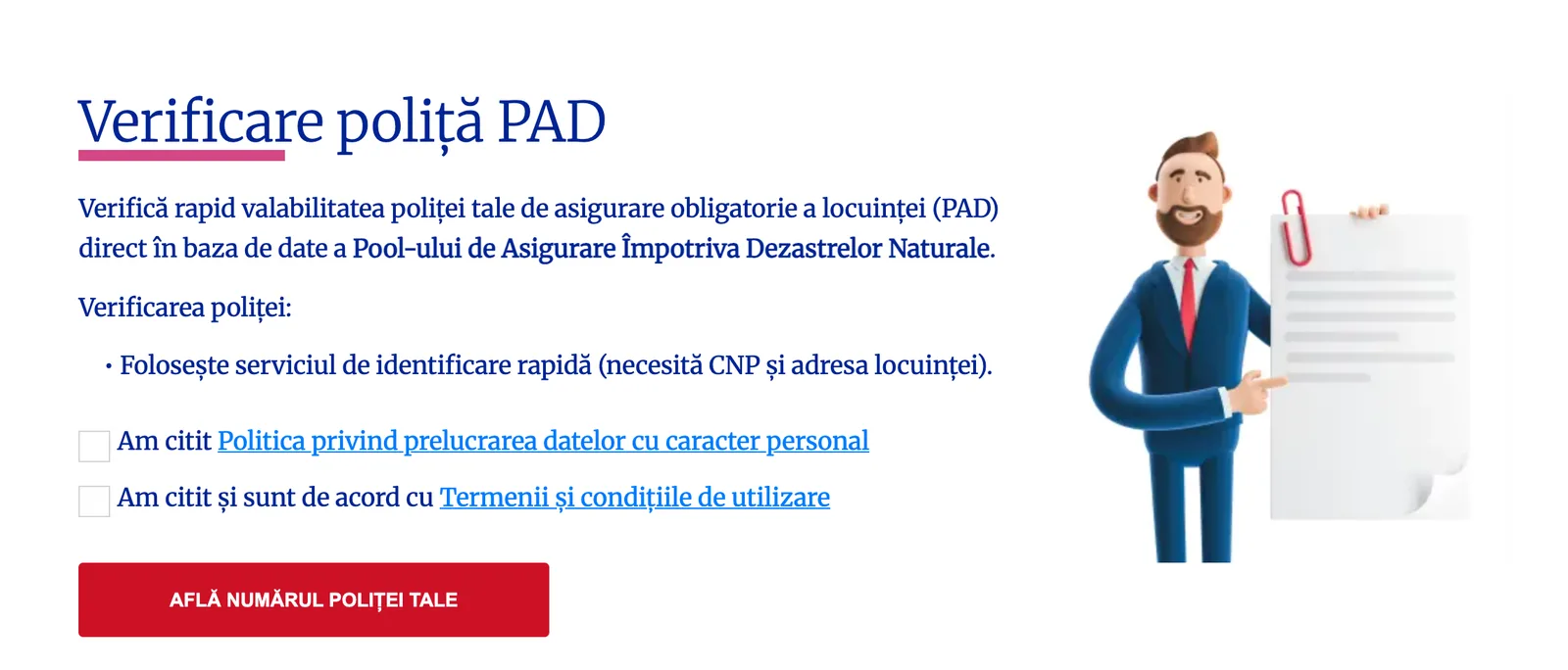
If you have a policy and cannot find it. The quick identification service at padrom.ro/myPad asks for your CNP (Romanian personal identification number) and the address of the home, and sends what it finds by e-mail or text message.
The first step looks like the screenshot below: tick the two confirmations (the personal data policy and the terms of use) and press "Află numărul poliței tale" (Find your policy number).
The fine and the city hall notices
Not having PAD is fined 100 to 500 lei. The breach is established by mayors and the people they authorise (Law 260/2008, art. 29).
City halls (primării) have access to the PAID database and, since January 15, 2024, send notices every six months to owners who have no PAD. If you received such a notice and think you have a policy, look it up with the check service above. If you do not have one, take one out.
What to do if you have a claim
- Report the damage as soon as possible, within 60 days of the disaster at the latest. The steps are on the PADROM claims page.
- Prepare the file. You need proof of ownership and confirmation of the event from the authorities.
- Wait for payment. PAID pays within 5 days at most of receiving the completed file.
Two things to know in advance:
- Unauthorised works that affect the structure rule out compensation for the affected part. Keep this in mind before a renovation.
- If you also have an optional policy, PAD pays first, and the optional policy covers what exceeds the PAD sum.
PAD when you sell or buy a home
Two rules from Law 260/2008:
- When a home is sold, a fully paid policy stays valid until the date in the contract, and the new owner becomes the beneficiary (art. 9).
- Registering the home in the carte funciară, or changing that registration, requires a PAD contract in force on the date of the application (art. 10).
If you are selling, keep the policy in force until the transaction is complete. If you are only starting to prepare the sale, see also how to prepare your home for sale.
If you are buying, both rules concern you directly. Ask the seller for the policy and look at the series (RA followed by 11 digits), the expiry date and whether it is fully paid. If it expires soon, make a note to renew it yourself. How to get a land register extract before signing is explained in our guide to the online extras de carte funciară (land register extract).
PAD and optional home insurance
- Optional home insurance (asigurare facultativă) cannot be taken out without PAD. The exception is buildings in seismic risk class I, which cannot have PAD until the strengthening works are formally accepted.
- Proof that you have PAD is the PAD policy itself or a policy in which PAID is a co-insurer.
- After damage from one of the three PAD risks, PAD pays first, up to the sum insured, and the optional policy covers what exceeds that sum (Law 260/2008, art. 19).
For a type A home, PAD pays at most 100,000 lei. If rebuilding your home would cost more, or if you also want cover for what is inside it, talk to an insurer about an optional policy and read the list of risks in the contract before you sign.
Frequently asked questions
What is PAID and how is it linked to the PAD policy?
PAID is the Pool-ul de Asigurare Împotriva Dezastrelor Naturale, Romania's Natural Disaster Insurance Pool. A genuine PAD policy carries the PAID logo in the top left corner, and after damage PAID pays the compensation, within 5 days at most of receiving the completed file.
Does PAD insurance cover furniture and the contents of the home?
No. Under Law 260/2008, PAD does not cover the contents of the home, nor outbuildings or fittings that are not structurally attached to the building. It covers the home against earthquakes, landslides and floods.
Is there one PAD policy for the whole apartment block?
No. In an apartment block, or a house with several homes, there is a separate contract for each home, so every owner has their own policy.
Who receives the PAD compensation if the home has several owners?
Each co-owner, according to their share. The compensation can be paid in full to one of them, with the written consent of the others, given before a notary or a lawyer.
Will I get state aid after a disaster if my home has no PAD?
Do not count on it. Law 260/2008 provides that the state may refuse aid for homes not insured with PAD.
Official sources
- Law no. 260/2008 on mandatory home insurance, republished, consolidated text (legislatie.just.ro)
- PADROM: Useful information (in Romanian)
- PADROM: Where to buy PAD (in Romanian)
- PADROM: Check that your PAD policy is genuine (in Romanian)
- PADROM: PAD policy check, myPad (in Romanian)
- PADROM: Claims (in Romanian)
- PADROM: PAD contract model, in force since March 1, 2026 (PDF, in Romanian)